
Copyright registration
The PCA assessment framework is registered with the Korea Copyright Commission.
- C-2025-058658
- C-2025-059731
- C-2025-059732
Once staff issue student accounts, students take the assessment through their school's own address. Staff check progress and department totals on the staff screen and download them as CSV.
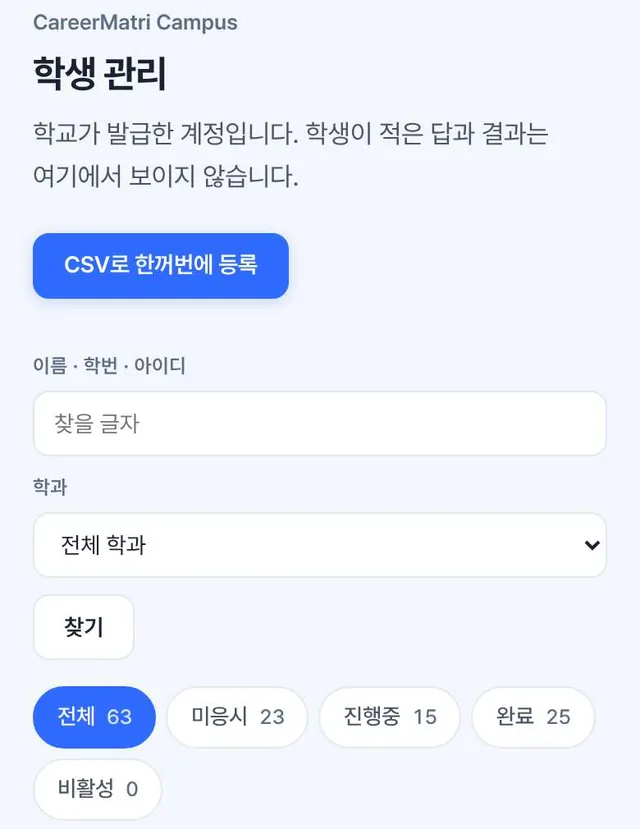
Everything from issuing student accounts to checking totals happens on the staff screen. There is nothing to install.
Decide which departments will take part and how many students. If a department's name differs from ours, we link it to the closest major assessment.
CareerMatri creates staff accounts for your school.
On the staff screen, issue IDs and passwords one at a time, or all at once from a CSV file.
Students go to the school's own address, choose their department and take the assessment.
See how many students have started and finished, along with department totals, on the staff screen.
Download rosters, progress and totals as CSV files.
Each school has its own address. Students choose their department there, log in with the ID they were given and start the assessment.
app.careermatri.com/campus/school-codeThe school code is set during onboarding.
Share a one-page English guide with international students. It explains what MAT does, what is free, and how to start. Students sign up and pay for themselves; nothing is charged to the school.
Download the one-page guide (PDF)
School passes and the assessment for departments are arranged by contract, as described above. Contact us for a contract.
Use this link in your newsletter or notice board. We count sign-ups by link, without names, so we can see which channels students use.
The link appears here.
The PCA assessment has also been used outside Korea. The assessment is in Korean. Three majors also have an English edition: Mechanical, Electrical and Electronic, and Computer Science.
Based on the ACADEMIX PCA introduction materials. Work in planned countries has not started yet.
The assessment framework is registered for copyright and was built with reference to Korean and international job and testing standards. Below, we keep what is finished separate from what is still in progress.
The PCA assessment framework is registered with the Korea Copyright Commission.
Job classifications and assessment design draw on the following standards.
We provide job information only, and students apply to jobs themselves.
Scores come from fixed rules only. The same answers always produce the same result, and school staff can trace how each result was reached.
Three majors have English items: Mechanical, Electrical and Electronic, and Computer Science. Each English item has the same number as its Korean item.
Whenever the assessment changes, we check that the same answers still produce the same result.
Whenever wording is edited, we compare each item to make sure it still measures the same thing.
We have prepared review materials for each major and are working through reviews with experts in each field.
We will analyze reliability and validity using real response data.
Once enough students have taken the assessment, we will build a baseline for comparison within each major.
Until a comparison baseline exists, reports do not show percentiles or rankings.
Every score comes from the formulas below. The formulas are the same for every department and country.
The average (1 to 5) of the items in a job area is rescaled to 0 to 100, so a 1 becomes 0, a 3 becomes 50 and a 5 becomes 100.
Error is estimated from how spread out the answers within an area are. It is calculated for each person rather than set as a fixed value.
Job area scores are mapped onto 8 activity axes (Analysis·Calculation, Design·Concept, Build·Test and others) through the weight matrix w.
Error is carried over with the same weights used to build each axis score, so each axis comes with its own measure of reliability.
Because axes draw on different numbers of areas, each axis is expressed relative to the same person's other axes to remove that bias.
For each job, activity preference ℓ = Σ v·z / Σ v is computed with the weights v of the axes that job emphasizes, then combined 3 : 1 with the work style score p.
Jobs with overlapping intervals are shown as one group instead of being ranked, so no job is placed above another by a margin smaller than the error.
Major assessments do not add up points. An area is backed by evidence only when at least 4 types of judgment C are confirmed, including every required type R for that area, and at least one piece of work O was produced.
Once real response data is available, we will calculate and publish internal consistency (Cronbach's α) for each area.
Two areas from the actual weight table of the Mechanical Engineering assessment. In each area, the weights add up to 1.
When weights change, we issue a new version. Earlier results stay the same.
Yes. Students take the major assessment linked to their department. Departments that share a major assessment still get examples and guidance suited to that department.
Yes. Students choose their degree stage on the first screen and answer questions that fit master's, PhD or postdoc level. You can also run it for a graduate school.
Tell us which departments will take the assessment, roughly how many students, and a staff contact. You upload the student roster on the staff screen when you issue accounts.
Yes. Students can log in and open their web report and PDF at any time.
It depends on the departments and number of students. Get in touch and we will explain the options that fit your school.
Request an introductionSend us your school name, departments and expected number of students, and we will get back to you once we have reviewed them.